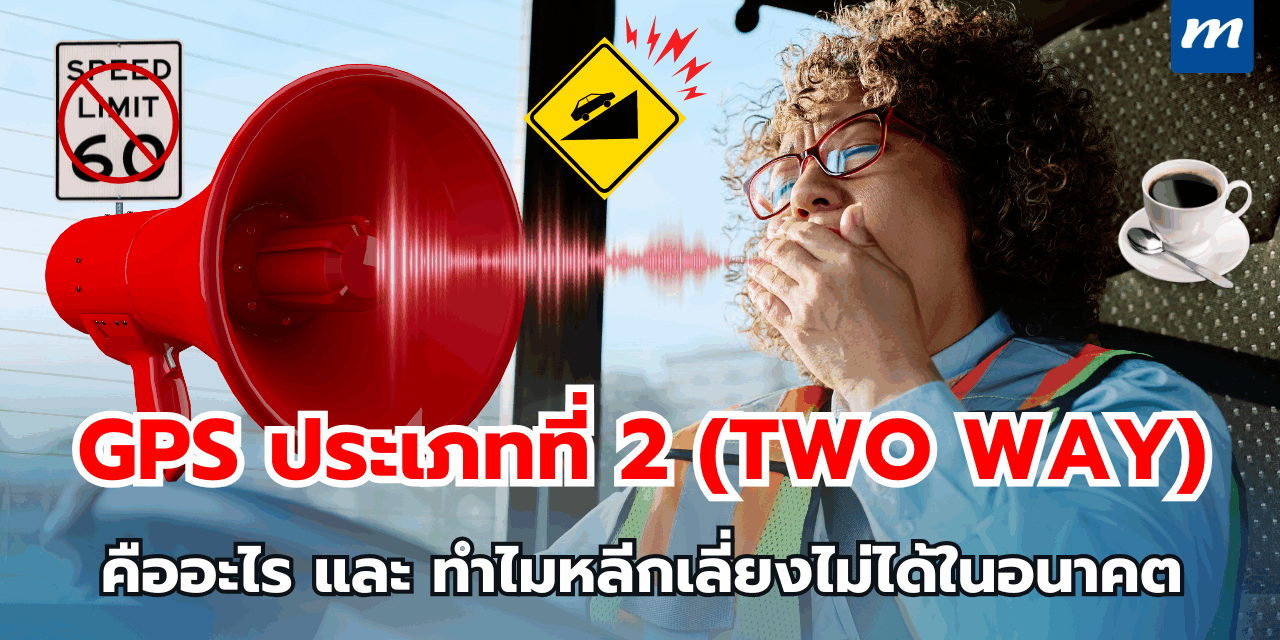
What Is Type 2 GPS (Two-Way GPS), and Why Is It Inevitable in the Future?
Type 2 GPS, or Two-Way GPS, is a vehicle tracking system that goes beyond simply transmitting location data to the Department of Land Transport (DLT). It functions as a proactive driver behavior management system, capable of issuing commands, sending alerts, and controlling risks in real time. This is why this type of GPS has been mandated for certain vehicle categories and is expected to be increasingly adopted across more sectors in the future.
The Difference Between Type 1 GPS and Type 2 GPS
Type 1 GPS (One-Way) is designed to transmit location data to the Department of Land Transport (DLT) for post-trip tracking and review. It does not provide active driver behavior alerts or real-time control functions.
Type 2 GPS (Two-Way) supports two-way communication, allowing it to both send and receive data. It can instantly alert drivers through onboard devices and help prevent accidents before they happen, rather than simply reviewing data after the fact. This system is not designed merely to track vehicle locations, but to actively manage risk and protect lives on the road.
Key Mandatory Functions of Type 2 GPS
1. Audible Alerts When Entering High-Risk Areas
The system automatically issues audible alerts to the driver as soon as the vehicle enters a high-risk area designated by the Department of Land Transport (DLT), such as steep slopes, continuous curves, mountainous roadsides, and routes with a history of frequent accidents. Example alert messages include “You are entering a high-risk area” or “You are on a dangerous route. Please drive with caution.”
2. Alerts for Driving Continuously for More Than 4 Hours
The system monitors the driver’s continuous driving time and immediately issues an alert when the allowed limit is exceeded, with messages such as “You have exceeded the permitted driving time. Please take a break.” This function is designed to reduce the risk of driver fatigue, which is a major cause of serious accidents.
3. Overspeed Alerts
Type 2 GPS links vehicle speed with area-specific conditions and road types. The system not only records speed data but also issues instant alerts when risky behavior occurs, with messages such as “You are exceeding the speed limit” or “Please reduce speed in a high-risk zone.”
High-Risk Areas Used for System Alerts
The system automatically sets alerts for key routes with high accident statistics and hazardous terrain, such as Mae Yang Ho–Mae Tieb, Chiang Mai–Doi Nang Kaew, Pua–Doi Phu Kha National Park, Bo Pho–Khok Ngam, Cho How–Phu Hin Rong Kla National Park, Kabin Buri Intersection–Wang Nam Khiao, and Khao Phap Pha–Phatthalung. Advance alerts in these areas have been proven to reduce accidents in practice, not just in theory.
Alert Formats
The system supports multi-level alerts to notify drivers before risks occur, including:
-
- You are entering a high-risk area.
- You are on a hazardous route.
- You have exceeded the permitted driving time.
- You are exceeding the speed limit.
All alerts are delivered in real time directly through the GPS device, without having to wait for incidents to occur or review reports afterward.
Who Should Prepare to Upgrade to Type 2 GPS?
The groups that should prepare include newly registered vehicles, vehicles replacing their GPS devices, transport and passenger vehicles as required by law, as well as businesses aiming to reduce accidents, minimize risk, and lower liability. While Type 1 GPS may still be acceptable today, it does not mean it will be sufficient for the future.
Conclusion: Enhancing Safety Is More Than Just a Regulatory Requirement
Type 2 GPS is not designed to place additional burdens on operators, but to serve as a tool to reduce unnecessary losses. MonoGPS is committed to proving its value through real-world performance on real roads and in real situations — not just through marketing claims. If you are considering whether your vehicles require Type 2 GPS or when an upgrade may be necessary, proactive planning will help reduce both costs and risks far more effectively than waiting for mandatory enforcement.
 English
  Thai
Thai